Class 9 Maths Triangles Worksheet — Free Printable PDF
Download a free Class 9 Maths worksheet on Triangles with MCQs, fill in the blanks and short answer questions. Complete answer key included. Personalized to your class, subject and chapter.
⭐ MeritMate — Class 9 Maths: Triangles
Curriculum-Aware · meritmate.inSection A: Multiple Choice Questions
Q1. In triangles ABC and DEF, AB = DE, AB is parallel to DE, BC = EF and BC is parallel to EF. The vertices A, B and C are joined to vertices D, E and F respectively. Which of the following is true?
a) ABED is a parallelogram but BCFE is not a parallelogram
b) BCFE is a parallelogram but ABED is not a parallelogram
c) ABED and BCFE are both parallelograms
d) ABCD is a parallelogram
Q2. In triangle ABC, the bisectors of angle B and angle C intersect each other at point O. Then angle BOC is equal to:
a) 90 degrees minus angle A divided by 2
b) 90 degrees plus angle A divided by 2
c) angle A divided by 2
d) 180 degrees minus angle A
Q3. If the altitudes from two vertices of a triangle to the opposite sides are equal, then the triangle is:
a) Scalene
b) Obtuse angled
c) Isosceles
d) Equilateral
Q4. In triangle PQR, PQ = PR and angle Q is 65 degrees. Then angle P is equal to:
a) 65 degrees
b) 50 degrees
c) 130 degrees
d) 30 degrees
Q5. By which congruence criterion can two triangles be proved congruent if two sides and the included angle of one triangle are equal to two sides and the included angle of the other triangle?
a) SSS
b) ASA
c) RHS
d) SAS
Section B: Fill in the Blanks
Q6. If two sides and the included angle of one triangle are equal to two sides and the included angle of another triangle, then the two triangles are congruent by the ________ criterion.
Q7. In an isosceles triangle ABC where AB = AC, the angles opposite to the equal sides, that is angle ABC and angle ACB, are ________.
Q8. The sum of any two sides of a triangle is always ________ than the third side.
Q9. If in triangles ABC and PQR, angle A = angle P, angle B = angle Q and AB = PQ, then the two triangles are congruent by the ________ congruence criterion.
Q10. A point that is equidistant from all the three vertices of a triangle is called the ________ of the triangle.
Section C: Short Answer Questions
Q11. In triangle ABC, AB = AC and the bisector of angle A meets BC at D. Prove that BD = DC.
In triangle ABD and triangle ACD:
AB = AC (given)
AD = AD (common side)
angle BAD = angle CAD (AD is the bisector of angle A)
Therefore, triangle ABD is congruent to triangle ACD by SAS congruence rule.
Hence, BD = DC by CPCT.
Q12. In triangles ABC and PQR, AB = QR, BC = PR and CA = PQ. State the correspondence of vertices and name the congruence criterion used.
The sides of the two triangles correspond as follows:
AB = QR, BC = PR, CA = PQ
Therefore, vertex A corresponds to vertex Q, vertex B corresponds to vertex R and vertex C corresponds to vertex P.
Triangle ABC is congruent to triangle QRP by the SSS congruence criterion.
Q13. If the bisector of the vertical angle of a triangle also bisects the base, prove that the triangle is isosceles.
Let triangle ABC have AD as the bisector of angle A, where D is the midpoint of BC so that BD = DC.
Extend AD to point E such that AD = DE and join CE.
In triangles ABD and ECD:
BD = DC (D is midpoint)
AD = DE (by construction)
angle ADB = angle EDC (vertically opposite angles)
Therefore, triangle ABD is congruent to triangle ECD by SAS.
So AB = EC and angle BAD = angle CED by CPCT.
Since angle BAD = angle CAD and angle BAD = angle CED, we get angle CAD = angle CED.
This means AC = EC in triangle ACE.
Therefore AB = AC, so triangle ABC is isosceles.
Q14. Prove that in a right triangle, the hypotenuse is the longest side.
Let triangle ABC be right angled at B, so angle B = 90 degrees.
Since the sum of all angles of a triangle is 180 degrees:
angle A + angle B + angle C = 180 degrees
angle A + 90 degrees + angle C = 180 degrees
angle A + angle C = 90 degrees
Therefore, both angle A and angle C are less than 90 degrees, which means both angle A and angle C are less than angle B.
In a triangle, the side opposite to the greater angle is longer.
Since angle B is greater than angle A, AC is greater than BC.
Since angle B is greater than angle C, AC is greater than AB.
Therefore, AC, which is the hypotenuse, is the longest side.
Q15. In triangle ABC, angle B = 45 degrees and angle C = 55 degrees. Determine the longest and shortest sides of the triangle.
The three angles of the triangle are:
angle A = 180 degrees minus 45 degrees minus 55 degrees = 80 degrees
angle B = 45 degrees
angle C = 55 degrees
Since the side opposite to the greater angle is longer:
angle A is the greatest, so BC (opposite to angle A) is the longest side.
angle B is the smallest, so AC (opposite to angle B) is the shortest side.
⭐ Answer Key
Class 9 · Maths · TrianglesAnswer Key
Q1. c) ABED and BCFE are both parallelograms
Q2. b) 90 degrees plus angle A divided by 2
Q3. c) Isosceles
Q4. b) 50 degrees
Q5. d) SAS
Q6. SAS (Side-Angle-Side)
Q7. Equal
Q8. Greater
Q9. ASA (Angle-Side-Angle)
Q10. Circumcentre
Q11. BD = DC proved using SAS congruence rule and CPCT
Q12. Triangle ABC is congruent to triangle QRP by SSS congruence criterion
More Class 9 Maths Worksheets
Want a different worksheet on Triangles?
Generate a fresh set of unique questions instantly. ✨ Generate My Free Worksheet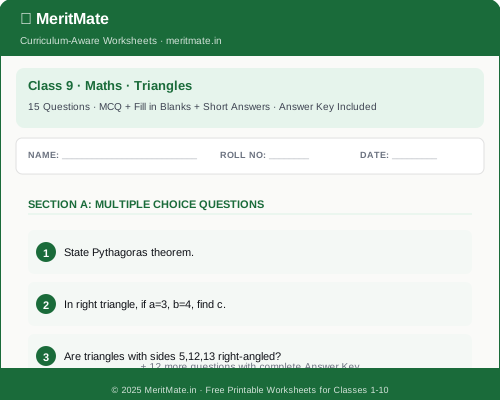
Sample preview — Download full worksheet with complete answer key