Class 6 Maths Geometry Worksheet — Free Printable PDF
Download a free Class 6 Maths worksheet on Geometry with MCQs, fill in the blanks and short answer questions. Complete answer key included. Personalized to your class, subject and chapter.
⭐ MeritMate — Class 6 Maths: Geometry
Curriculum-Aware · meritmate.inSection A: Multiple Choice Questions
Q1. How many dimensions does a point have?
a) 0
b) 1
c) 2
d) 3
Q2. The number of lines that can be drawn through two given points is:
a) 0
b) 1
c) 2
d) Infinite
Q3. An angle measuring exactly 90 degrees is called a:
a) Acute angle
b) Obtuse angle
c) Right angle
d) Straight angle
Q4. A triangle with all three sides equal is called:
a) Scalene triangle
b) Isosceles triangle
c) Equilateral triangle
d) Right triangle
Q5. Which of the following has no endpoints?
a) Line segment
b) Ray
c) Line
d) Angle
Section B: Fill in the Blanks
Q6. A flat surface that extends infinitely in all directions is called a ________.
Q7. An angle greater than 90 degrees but less than 180 degrees is called an ________.
Q8. Two lines that never meet and are always the same distance apart are called ________.
Q9. The point where two rays meet to form an angle is called the ________.
Q10. A polygon with six sides is called a ________.
Section C: Short Answer Questions
Q11. What is the difference between a line segment and a ray? Give one example of each from daily life.
Q12. Define parallel lines and perpendicular lines. How are they different from each other?
Q13. Name and define the three types of triangles based on their angles.
Q14. What is a polygon? List any four types of polygons along with the number of their sides.
Q15. Measure and classify the following angles: 45 degrees, 120 degrees, 180 degrees, and 75 degrees.
⭐ Answer Key
Class 6 · Maths · GeometryAnswer Key
Section A: Multiple Choice Questions
Q1. Answer: a) 0
A point has no length, breadth, or height. It has no dimension and simply marks a location in space.
Q2. Answer: b) 1
Through any two given points, one and only one straight line can be drawn.
Q3. Answer: c) Right angle
An angle that measures exactly 90 degrees is called a right angle.
Q4. Answer: c) Equilateral triangle
A triangle in which all three sides are equal in length is called an equilateral triangle.
Q5. Answer: c) Line
A line extends infinitely in both directions and has no endpoints. A ray has one endpoint and a line segment has two endpoints.
Section B: Fill in the Blanks
Q6. plane
Q7. obtuse angle
Q8. parallel lines
Q9. vertex
Q10. hexagon
Section C: Short Answer Questions
Q11. A line segment has two fixed endpoints and a definite length. A ray has one endpoint and extends infinitely in one direction.
Example of line segment: A scale or ruler represents a line segment.
Example of ray: A beam of light coming from a torch represents a ray.
Q12. Parallel lines are two lines that lie in the same plane and never intersect each other, no matter how far they are extended. Example: Railway tracks.
Perpendicular lines are two lines that intersect each other at exactly 90 degrees. Example: The corner of a room.
Difference: Parallel lines never meet, while perpendicular lines meet at a right angle.
Q13. The three types of triangles based on angles are:
Acute triangle: A triangle in which all three angles are less than 90 degrees.
Right triangle: A triangle in which one angle is exactly 90 degrees.
Obtuse triangle: A triangle in which one angle is greater than 90 degrees.
Q14. A polygon is a closed flat figure made up of three or more straight line segments called sides.
Four types of polygons:
Triangle has 3 sides.
Quadrilateral has 4 sides.
Pentagon has 5 sides.
Hexagon has 6 sides.
Q15. 45 degrees is an acute angle because it is less than 90 degrees.
120 degrees is an obtuse angle because it is greater than 90 degrees but less than 180 degrees.
180 degrees is a straight angle because it forms a straight line.
75 degrees is an acute angle because it is less than 90 degrees.
More Class 6 Maths Worksheets
Want a different worksheet on Geometry?
Generate a fresh set of unique questions instantly. ✨ Generate My Free Worksheet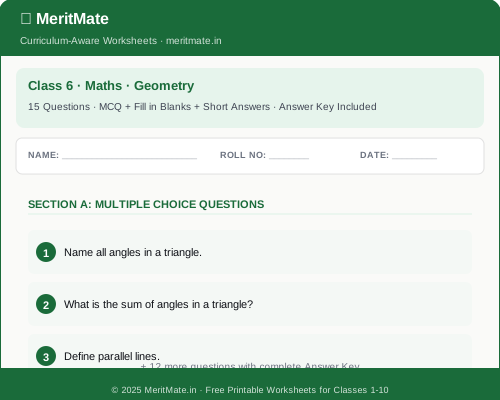
Sample preview — Download full worksheet with complete answer key