Class 10 Maths Arithmetic Progressions Worksheet — Free Printable PDF
Download a free Class 10 Maths worksheet on Arithmetic Progressions with MCQs, fill in the blanks and short answer questions. Complete answer key included. Personalized to your class, subject and chapter.
⭐ MeritMate — Class 10 Maths: Arithmetic Progressions
Curriculum-Aware · meritmate.inSection A: Multiple Choice Questions
Q1. The common difference of the arithmetic progression 3, 7, 11, 15, ... is
a) 3
b) 4
c) 7
d) 11
Q2. The 10th term of the AP 2, 7, 12, 17, ... is
a) 45
b) 47
c) 52
d) 57
Q3. The sum of first 20 terms of the AP 1, 3, 5, 7, ... is
a) 300
b) 360
c) 400
d) 420
Q4. Which of the following is an arithmetic progression?
a) 1, 2, 4, 8, 16
b) 1, 1, 2, 3, 5
c) 2, 5, 8, 11, 14
d) 1, 4, 9, 16, 25
Q5. If the first term of an AP is 5 and the common difference is -2, then the 8th term is
a) -9
b) -7
c) 9
d) 19
Section B: Fill in the Blanks
Q6. The general term (nth term) of an AP with first term a and common difference d is given by ________
Q7. The sum of first n natural numbers is ________
Q8. If the nth term of an AP is 4n + 1, then the common difference of the AP is ________
Q9. The number of terms in the AP 7, 13, 19, ..., 205 is ________
Q10. If the first term of an AP is 6, last term is 106 and sum of all terms is 1120, then the number of terms is ________
Section C: Short Answer Questions
Q11. Find the 25th term of the AP 3, 8, 13, 18, ...
Q12. How many terms of the AP 24, 21, 18, ... must be taken so that their sum is 78?
Q13. The 7th term of an AP is 32 and its 13th term is 62. Find the AP.
Q14. Find the sum of all two-digit odd numbers.
Q15. The sum of first n terms of an AP is given by Sn = 3n squared + 5n. Find the AP and the common difference.
⭐ Answer Key
Class 10 · Maths · Arithmetic ProgressionsAnswer Key
Q1. b) 4
Explanation: d = 7 - 3 = 4
Q2. b) 47
Explanation: a10 = 2 + (10 - 1) x 5 = 2 + 45 = 47
Q3. c) 400
Explanation: S20 = 20/2 x (2 x 1 + 19 x 2) = 10 x 40 = 400
Q4. c) 2, 5, 8, 11, 14
Explanation: The common difference is constant at 3
Q5. b) -9
Explanation: a8 = 5 + (8 - 1) x (-2) = 5 - 14 = -9
Q6. an = a + (n - 1)d
Q7. n(n + 1)/2
Q8. 4
Explanation: an = 4n + 1, so a1 = 5 and a2 = 9, therefore d = 9 - 5 = 4
Q9. 34
Explanation: 205 = 7 + (n - 1) x 6, so 198 = (n - 1) x 6, therefore n - 1 = 33, giving n = 34
Q10. 20
Explanation: Sn = n/2 x (a + l), so 1120 = n/2 x (6 + 106) = n/2 x 112 = 56n, therefore n = 20
Q11. a = 3, d = 5
a25 = 3 + (25 - 1) x 5 = 3 + 120 = 123
Q12. Sn = n/2 x (2 x 24 + (n - 1) x (-3)) = 78
n/2 x (48 - 3n + 3) = 78
n(51 - 3n) = 156
51n - 3n squared = 156
3n squared - 51n + 156 = 0
n squared - 17n + 52 = 0
(n - 4)(n - 13) = 0
n = 4 or n = 13
Both values are valid. When n = 13, the sum is still 78 because terms after a certain point become negative and cancel out the extra positive sum.
Q13. Let first term be a and common difference be d.
a7 = a + 6d = 32 ... (i)
a13 = a + 12d = 62 ... (ii)
Subtracting (i) from (ii): 6d = 30, so d = 5
From (i): a + 30 = 32, so a = 2
The AP is 2, 7, 12, 17, ...
Q14. Two-digit odd numbers: 11, 13, 15, ..., 99
a = 11, d = 2, l = 99
n = (99 - 11)/2 + 1 = 45
Sum = 45/2 x (11 + 99) = 45/2 x 110 = 45 x 55 = 2475
Q15. Sn = 3n squared + 5n
S1 = 3(1) + 5(1) = 8, so a1 = 8
S2 = 3(4) + 5(2) = 12 + 10 = 22, so a2 = 22 - 8 = 14
S3 = 3(9) + 5(3) = 27 + 15 = 42, so a3
More Class 10 Maths Worksheets
Want a different worksheet on Arithmetic Progressions?
Generate a fresh set of unique questions instantly. ✨ Generate My Free Worksheet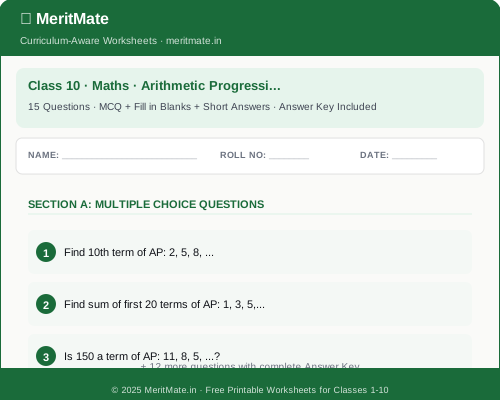
Sample preview — Download full worksheet with complete answer key